
Third Grade
English Language Arts
Grades 3 Ages 7-9 2 Live Classes
Reading Comprehension | Grammar | Writing Skills
Ongoing
Open Enrollment


$30
per week
Paragraph
Writing
Reading Comprehension
Vocabulary Development
Literature
Study

Small Group Learning

Builds
Confidence
Small Class
2-6 students

45-Minute
Live Class

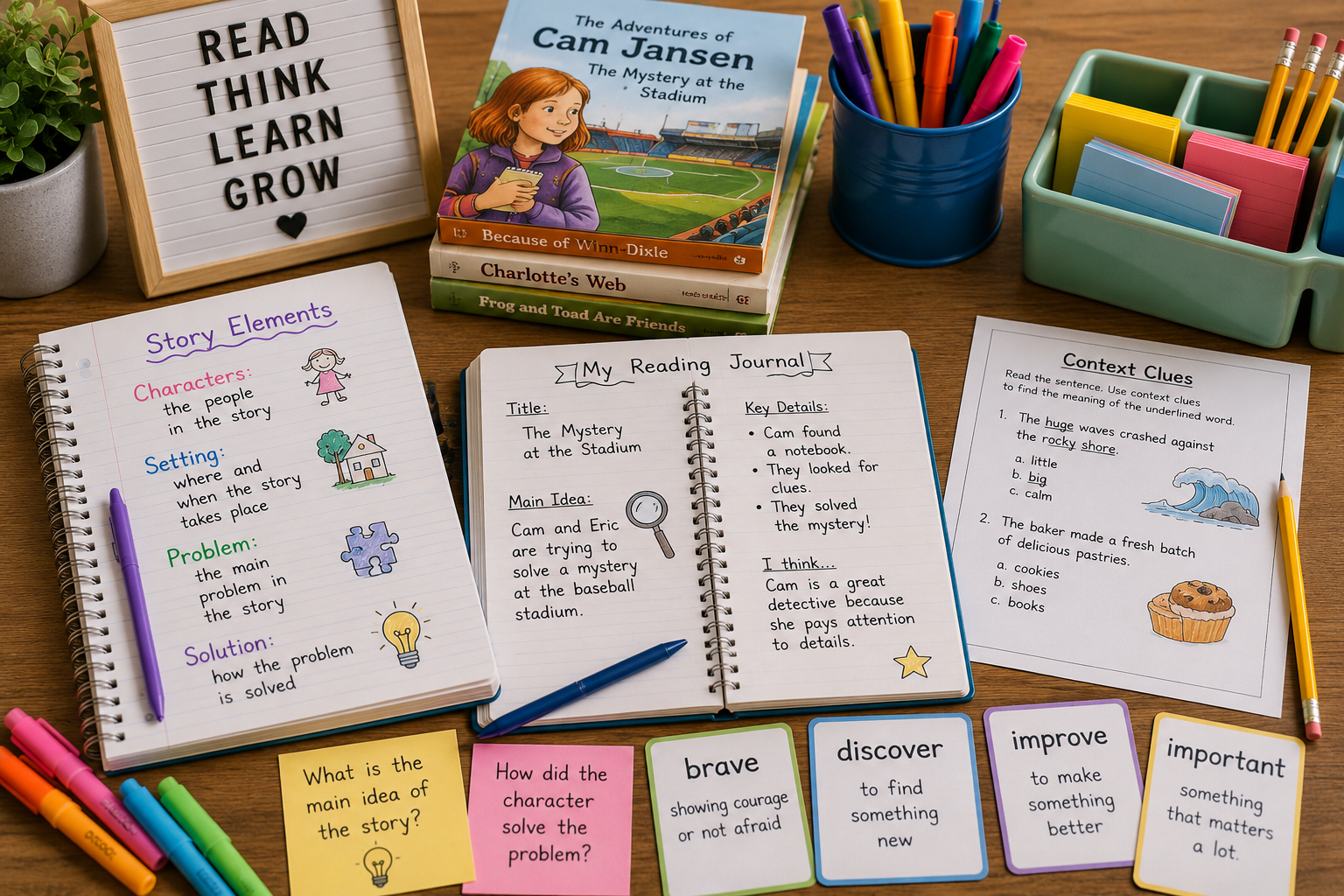
This class is ideal for students ages 7–10 or learners working at a third-grade level. This course helps students strengthen reading comprehension, paragraph writing, vocabulary, grammar, and critical-thinking skills while preparing for the increased independence and rigor of upper-elementary ELA.
Skills Students Practice


Critical
Thinking
Grammar &
Language
Why Parents Love This Class
Strong Reading Comprehension
Develops Writing Skills
Class Structure

Greetings & Review

Reading & Skills Instruction

Guided Practice

Independent Practice

Activity, Share, & Reflect
Grammar & Mechanics
Vocabulary Expansion
Literary Analysis Foundations
Third Grade Literacy Review
Reading Comprehension Strategies
Paragraph Development
Narrative Writing
Informational Writing
Curriculum Highlights
Join Anytime!
Open Enrollment
45-minute live class
Affordable- just $30 per week
Engaging and educational
-
Once you submit a request or sign up for an existing class, our team will reach out to you with final details. Classes are live on Zoom and use Google Classroom for communication and assignments.
-
No problem! You can still enroll. Each class reviews prior concepts and includes a lesson independent of the prior one. Feel free to join any session that works for your schedule.
-
No! No prior knowledge or experience is needed. Our teachers meet your child where they are and work from there!
-
A paper and pencil is all they need. The teacher will post a message in the classroom if they need anything else.
-
We keep our group sizes small so that each child gets the attention they need to succeed. You can expect a maximum of 6 students.
-
At this time, we cannot guarantee that a recording will be available.
-
Yes! In addition to being credentialed and experienced, every teacher is background checked every year.
-
Yes! This course is everything your child will need.
Learning
Unit One: Vocabulary -focus on learning new vocabulary through the concepts of synonyms, antonyms, suffixes, homophones, and idioms. Learners will be guided to use a dictionary to help learn definitions and the target concept. They will be encouraged to use the concepts in writing and share their work with their peers.
Class 1: Synonyms
Class 2: Antonyms
Class 3: Prefixes
Class 4: Suffixes
Class 5: Homophones
Class 6: IdiomsUnit Two: Processing -use the book The True Story of the 3 Little Pigs by Job Scieszka and select non-fiction articles to learn and practice skills of predicting what might happen next, the difference between summarizing and paraphrasing, visualizing what a text is trying to illustrate and writing in a way to help others visualize, the purpose and power of questioning story plots, and learning to identify and write text written with clarity.
Class 1: Predict
Class 2: Summarize
Class 3: Paraphrase
Class 4: Visualize
Class 5: Question
Class 6: ClarifyUnit Three: Literature- read select literature to focus on the main ideas and themes of the story, and learn and practice skills that include identifying and using story elements such as characters, settings, plots, conflicts, and resolutions to form ideas around inferences, conclusions, and generalizations.
Class 1: Inferences, conclusions, generalization
Class 2: Main Idea, theme, supporting details
Class 3: Summarizing and paraphrasing text
Class 4: Identifying and comparing and contrasting characters
Class 5: Identifying and describing settings
Class 6: Identifying the plot, conflict, and resolution with story elementsUnit Four: Paragraph Writing- learn different types of paragraphs and practice writing them, introduction of grammar points to include in writing
Class 1: Parts and Types of Paragraphs
Class 2: Opinion Paragraphs
Class 3: Narrative Paragraphs
Class 4: Descriptive Paragraphs
Class 5: Informational Paragraphs
Class 6: Persuasive ParagraphsUnit Five: Comprehending Informational Text Part 1- read select informational texts to determine and understand the main idea and supporting details, decipher non-literal meanings, work out the point of view and author's purpose, and compare and contrast similar texts
Class 1: Main Idea and Supporting Details
Class 2: Non-Literal Meanings
Class 3: Context Clues and Point of View
Class 4: Author's Purpose
Class 5: Compare and Contrast Informational Text
Class 6: Academic VocabularyUnit Six: Comprehending Information Text Part 2- read select informational texts to decipher charts and graphs, learn about sequential orders, fact and opinion, cause and effect, and summarizing text
Class 1: Charts and Graphs
Class 2: More Advanced Vocabulary
Class 3: Sequential Order
Class 4: Facts vs. Opinion
Class 5: Cause and Effect
Class 6: Summarizing textsUnit 7: Tall Tales and Fairy Tales- read select tall tales and fairy tales to explore this type of text and analyze their parts, as well as writing one of each
Class 1: Tall Tales Exploration
Class 2: Tall Tales Analyzation
Class 3: Write a Tall Tall
Class 4: Fairy Tales Exploration and Analyzation
Class 5: Fairy Tale Comparison
Class 6: Write a Fairy TaleUnit 8: Poetry- read select poetry pieces and learn about the different types of poetry while analyzing their central message, as well as writing different types
Class 1: Intro and Vocab part 1
Class 2: Intro and Vocab part 2
Class 3: Identify and Analyze
Class 4: Comparing Like Pieces
Class 5: Writing using Key Words and Objects
Class 6: Writing Acrostics and HaikusUnit 9: Introduction to Research- Learn what plagiarism is and explore the basics of how to research and use online sources
Class 1: Plagiarism
Class 2: Beginning Research
Class 3: Using Search Engines (Google)
Class 4: Evaluating Sources
Class 5: So your Research
Class 6: Citations and ProjectsUnit 10: Essays- Learn the process of writing an essay and produce a multi-paragraph narrative essay with plenty of teacher feedback along the way
Class 1: Process and Parts of an Essay
Class 2: Brainstorm and Outline
Class 3: Outline Completion, Drafting
Class 4: Draft
Class 5: Peer Reviews and Revising
Class 6: Final Format (MLA style) and ShareUnit 11: Essays- Learn the process of writing an essay and produce a multi-paragraph explanatory essay with plenty of teacher feedback along the way
Class 1: Process and Parts of an Essay
Class 2: Brainstorm and Outline
Class 3: Outline Completion, Drafting
Class 4: Draft
Class 5: Peer Reviews and Revising
Class 6: Final Format (MLA style) and ShareUnit 12: Essays- Learn the process of writing an essay and produce a multi-paragraph persuasive essay with plenty of teacher feedback along the way
Class 1: Process and Parts of an Essay
Class 2: Brainstorm and Outline
Class 3: Outline Completion, Drafting
Class 4: Draft
Class 5: Peer Reviews and Revising
Class 6: Final Format (MLA style) and ShareUnit 13: Note-Taking and Creative Writing- Learn and practice taking notes on text and videos with 3 different methods and write creatively using story elements and dice for inspiration
Class 1: Note-Taking Key Word Outline
Class 2: Note-Taking Concept Maps
Class 3: Note-Taking Sketch Notes
Class 4: Creative Writing 1
Class 5: Creative Writing 2
Class 6: Creative Writing 3Miscellaneous
This class has 72 individual sessions and will run for 36 weeks with 2 sessions a week.
Classes are stand-alone sessions, so students can enroll and withdraw at any time.
FAQ